

Introduction
Green bonds are debt instruments issued to raise funds for environmentally friendly projects. They function similarly to traditional bonds but with the key difference that they play a vital role in channeling funds into projects that contribute directly to India's sustainability goals. This includes projects like solar and wind energy, waste management, and clean water supply, which are critical to India's sustainability goals. Green bonds have become a vital component of India's financial landscape, offering a unique opportunity for investors to contribute to sustainable development while earning returns.
The Indian government has been proactive in promoting green bonds. In 2015, it launched the Green Bond Scheme, offering tax incentives to companies issuing green bonds. Additionally, the government has set up funds like the Green Bond Fund and the Green Infrastructure Fund to support green projects .
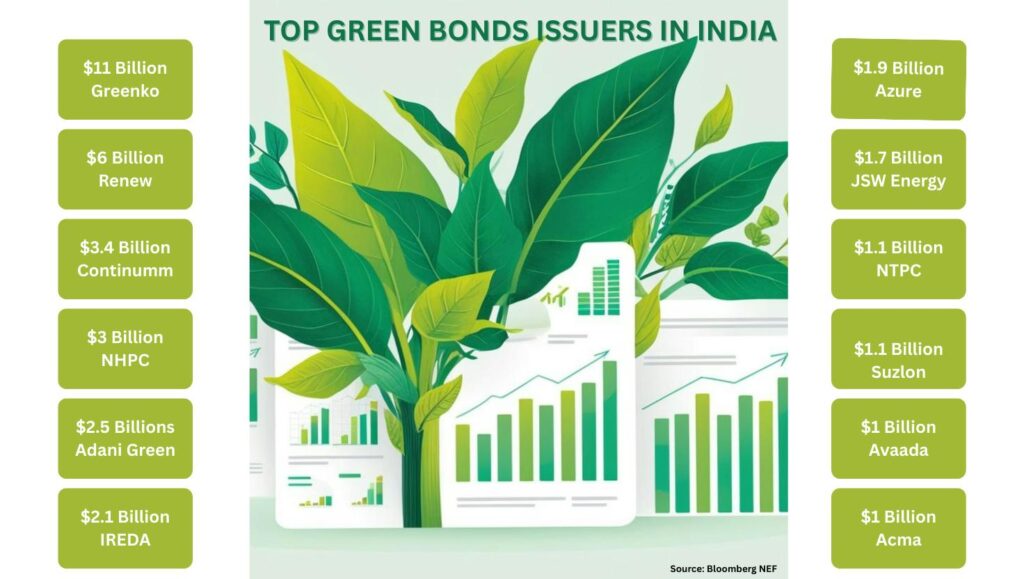
As India continues to navigate its energy transition and address climate change, the role of green bonds is expected to grow, supporting the nation's commitment to a greener future. The future of green bonds in India looks promising, with the private sector playing a significant role in issuances.
Sovereign Green Bonds
Earlier, only Indian residents were allowed to invest in green bonds. However, the Reserve Bank of India (RBI), through a circular (RBI/2023-24/81), has allowed non-resident Indians (NRIs) to invest in the government’s Sovereign Green Bonds issued for 2023-24. This introduction increases the pool of potential investors. A wider investor base could also improve the liquidity of green bonds, making them more attractive for both foreign and domestic investors.
In 2023, India issued its first sovereign green bonds to mobilize resources for green infrastructure in January and February 2023, worth INR 160 billion. These bonds are part of the government's strategy to reduce carbon intensity and expand renewable energy production. The proceeds from these bonds are allocated to public sector projects that support climate resilience and sustainable development goals . GoI came out with a SGrB Framework aligned with the Green Bond Principles laid down by International Capital Market Association (ICMA) . Subsequently, the SGrBs were auctioned by RBI in various tranches starting from January 2023. Details of the issuances are given below.
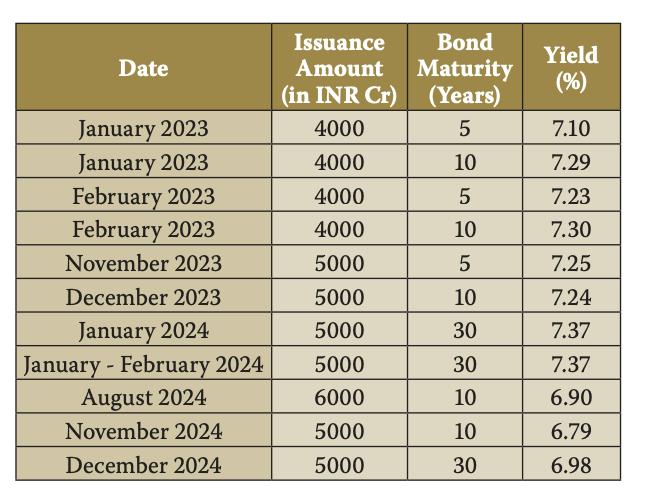
Additionally, as per the RBI’s issuance calendar for marketable dated securities for October 2024 – March 2025, RBI is going to auction around INR 20, 000 Cr of SGrBs in the current financial year 2024-25 through four SGrB issuances (two of 10-years tenor and two of 30-years tenor) of Rs 5,000 crore each .
Categories Of Green Bonds
According to the SEBI Circular on green debt securities dated 30th May 2017, debt security will be termed as green if the raised funds are utilized towards the following categories:
-
Renewable and sustainable energy include wind, solar, bioenergy, and other sources of energy that use clean technology.
-
Clean transportation, including mass/public transportation, etc.
-
Sustainable water management, including clean and drinking water, water recycling, etc.
-
Climate change adaptation.
-
Sustainable waste management, including recycling, waste to energy, efficient disposal of wastage, etc.
-
Sustainable land use, including sustainable forestry and agriculture, afforestation, etc.
-
Biodiversity conservation and any other category may be notified by the SEBI.